Hormone Therapy for Menopause: Personalized Relief for the Symptoms No One Warned You About
Author
Joe Plankinton Jr.
Date Published
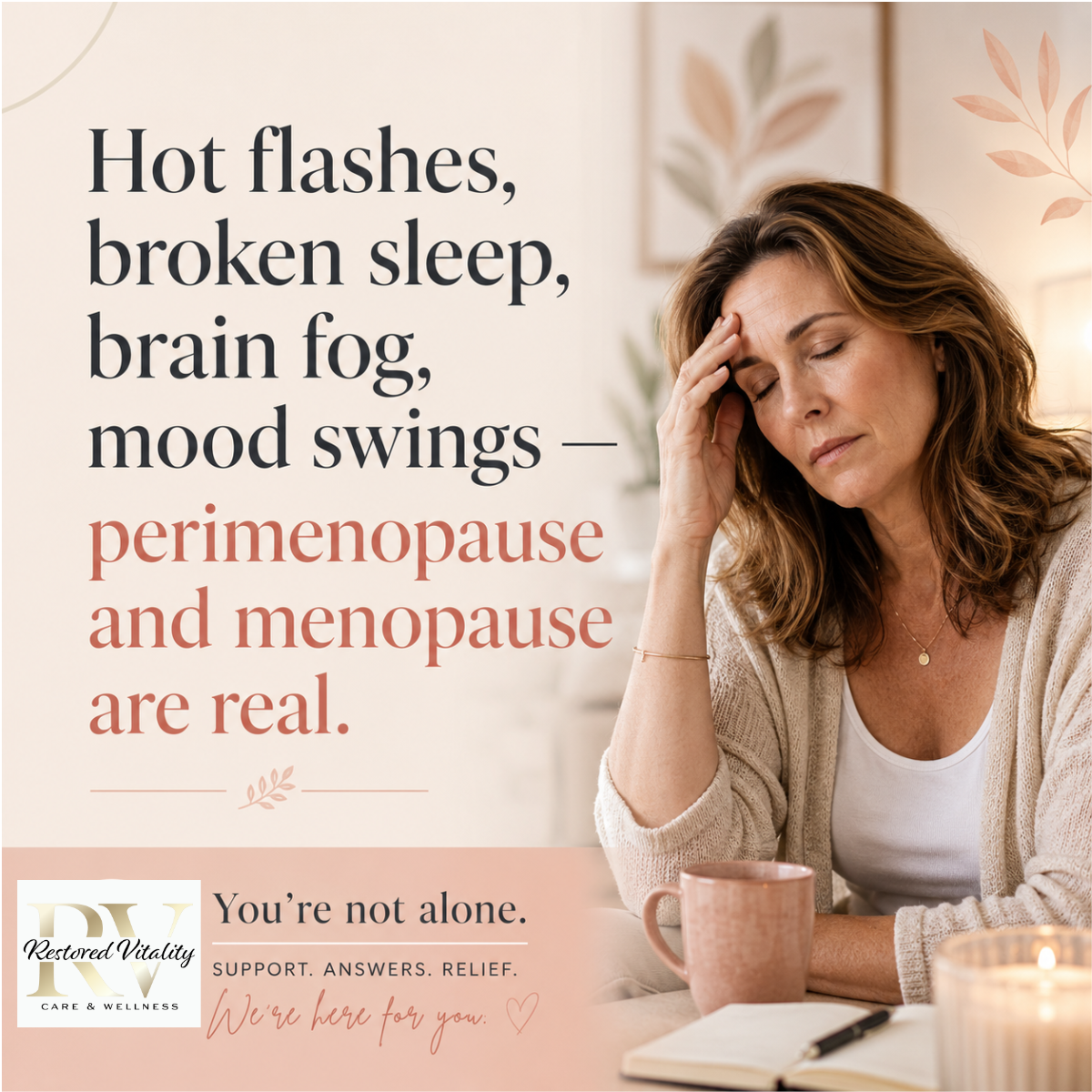
Hormone Therapy for Menopause: Personalized Relief for the Symptoms No One Warned You About
For a lot of women, the hardest part of perimenopause isn't any single symptom — it's not realizing that's what's happening. The sleep that won't come. The mood that swings without warning. The weight that settles around your middle no matter what you do. The word that's right on the tip of your tongue and just... won't arrive. It's easy to chalk it all up to stress, age, or "just being busy."
But these shifts often have a clear, treatable cause: your hormones are changing. And you don't have to white-knuckle your way through it. At Restored Vitality in Overland Park, we help women understand what's happening in their bodies and, when it's the right fit, use personalized hormone therapy to bring things back into balance.
Perimenopause vs. menopause: what's the difference?
These terms get used interchangeably, but they describe different stages.
Perimenopause is the transition leading up to menopause. It often begins in your late 30s or early 40s, and it can last anywhere from four to eight years. During this time, your ovaries produce estrogen and progesterone unpredictably — not in a smooth decline, but in peaks and dips that can leave you feeling like a different person week to week.
Menopause is the point at which you've gone 12 consecutive months without a period. For most women, that happens around age 51. Everything after is post-menopause.
One thing we want every patient to hear: this is a natural transition, not something broken about you. The goal of care isn't to "fix" you — it's to make the transition far more comfortable.
What's actually happening in your body
It helps to know what these hormones do, because their ups and downs explain so many of the symptoms:
- Estrogen influences your brain, bone density, and skin hydration. When it fluctuates, you may notice mood changes, foggy thinking, dryness, and hot flashes.
- Progesterone supports sleep and stress resilience. As it dips, sleep often becomes the first casualty.
- Testosterone (yes, women have it too) contributes to libido, motivation, and lean muscle. Lower levels can quietly drain your energy and drive.
Because these hormones don't simply fall in a straight line — they swing — symptoms can feel inconsistent and confusing. That's normal, and it's part of why a lab panel is so useful.
Symptoms that are easy to overlook
Many women don't connect these to hormones at all. If several of these sound familiar, it's worth a conversation:
- Trouble falling or staying asleep
- Anxiety, irritability, or mood swings
- Vaginal dryness or discomfort during intimacy
- Lower libido
- Hair thinning
- Weight gain, especially around the midsection
- Brain fog and forgetfulness
- Heavier, more intense PMS or unpredictable bleeding
What hormone replacement therapy actually is
Hormone replacement therapy (HRT) is a medical treatment that replenishes the hormones your body is producing less of, easing the symptoms that come with the drop. When it's appropriate, it's one of the most effective tools available for menopause symptoms.
Modern HRT is highly customizable. Depending on your needs and labs, a plan may include estrogen, progesterone, and sometimes testosterone, delivered in whatever form fits your life:
- Patches
- Gels and creams
- Oral capsules
- Vaginal rings or creams (especially for local dryness)
Many plans use bioidentical hormones — hormones that are structurally identical to the ones your body makes naturally. The right combination and delivery method is something we determine together, based on your symptoms, your labs, and your health history.
The benefits, when it's a good fit
For women who are good candidates, well-managed HRT can:
- Reduce the frequency and intensity of hot flashes
- Improve sleep and ease night sweats
- Restore vaginal comfort and tissue health
- Help protect against bone loss and osteoporosis
- Support mood stability and mental clarity
- Potentially benefit heart health when started within about 10 years of menopause
The aim isn't to turn back the clock — it's to help you feel steady, rested, and like yourself again.
Let's talk honestly about the risks
You may have heard scary headlines about hormone therapy, and you deserve a straight answer. HRT does carry some risks — including a possible increase in blood clots, stroke, or breast cancer — and those risks tend to be higher when therapy is started later in life or without proper monitoring.
But the picture is far more nuanced than the headlines suggested. For many healthy women in their 40s and 50s, started at the right time and supervised properly, the benefits often outweigh the risks. The key words are individualized and supervised. That's why we never hand out a one-size-fits-all prescription — your plan is built around your labs, your history, and your goals, and it's monitored over time.
How we approach hormone care at Restored Vitality
Good hormone care starts with data, not guesswork. Our process typically includes:
- An in-depth consultation to understand your symptoms, history, and what you want to feel like again.
- A comprehensive hormone panel — we look at estrogen, progesterone, testosterone, thyroid function, and related markers, because symptoms can overlap.
- A personalized, conservative plan. We start low, track your progress, and adjust. Your feedback drives the dose.
- Ongoing support, because hormones interact with sleep, nutrition, stress, and metabolism — and we want the whole picture working for you.
Our hormone membership is designed to make this kind of ongoing, monitored care simple and consistent, rather than a one-time visit and a prescription you're left to manage alone.
When to talk to a clinician
It's worth reaching out if you're experiencing:
- Irregular or heavy bleeding
- Spotting after intimacy, or any bleeding after 12 months without a period
- Hot flashes, vaginal dryness, or brain fog that's interfering with your life
- Symptoms after a surgical menopause (hysterectomy) or cancer treatment
- Simple curiosity about whether HRT is right for you
(Any new or unusual bleeding always deserves a prompt evaluation.)
Frequently asked questions
Is hormone therapy safe?
For the right candidate, started at the right time and properly monitored, HRT is considered safe and effective for many women. Safety depends on your individual health history — which is exactly what a consultation and lab panel sort out.
What are bioidentical hormones?
They're hormones structurally identical to the ones your body produces. They come in both FDA-approved and custom-compounded forms, and we'll discuss which is appropriate for you.
Do I have to be fully in menopause to start?
No. Many women benefit from support during perimenopause, when symptoms often begin years before their final period.
Will hormone therapy help me lose weight?
HRT isn't a weight-loss treatment, but by improving sleep, energy, and balance, many women find it easier to maintain healthy habits. If weight is a primary concern, we can talk about our dedicated medical weight-loss program too.
Is this only for women?
Hormone changes affect men as well. While this article focuses on menopause, we also support men experiencing fatigue, low drive, and other symptoms of shifting hormones — just ask.
You don't have to push through it alone
If perimenopause or menopause is making you feel like a stranger in your own body, let's talk. A consultation is a low-pressure, education-first conversation — we'll explain your options, run the right labs, and help you decide what makes sense for you. Restored Vitality is located in Overland Park and serves the greater Kansas City area.
Schedule your hormone consultation at restored-vitality.com or visit us in Overland Park, KS — and feel like yourself again.
This article is for general education and isn't medical advice. Hormone replacement therapy requires evaluation and ongoing supervision by a qualified provider, and it isn't appropriate for everyone. Individual results and risks vary.
Wondering if dermal fillers are right for you? Our Overland Park team explains how Restylane works, what it treats, who's a good candidate, and what to expect.
Wondering if dermal fillers are right for you? Our Overland Park team explains how Restylane works, what it treats, who's a good candidate, and what to expect.